
Dental implant cost can vary significantly from one Houston provider to another, even when patients are replacing what seems like the same missing tooth. Many Houston patients are surprised when two offices quote very different fees for what appears to be the same treatment. Understanding why some dental implants are more expensive than others starts with one core fact: a dental implant is not a retail product, but a customized medical treatment built around bone, gums, bite, and long-term function. This article explains what actually drives cost, what higher fees may be paying for, and how to compare implant recommendations without missing the details that affect longevity.
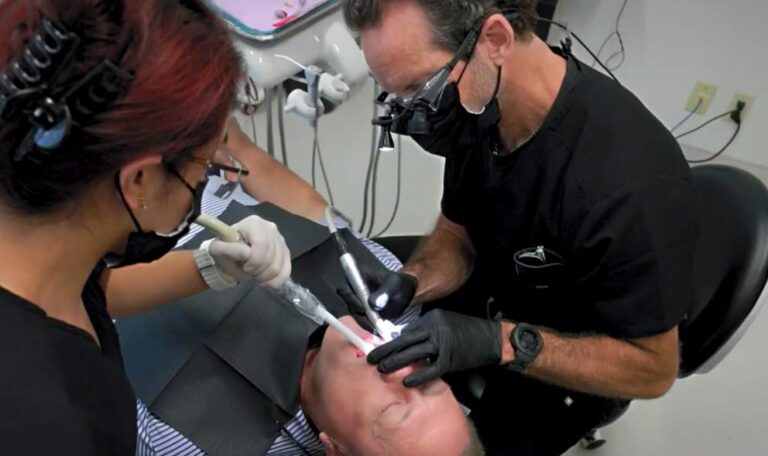
Why Dental Implant Cost Varies in Houston
Implant pricing varies because the fee covers far more than the screw placed in the jaw. A complete treatment plan may include digital treatment planning, guided implant surgery, healing evaluations, the final restoration, and follow-up visits, all of which influence predictability more than the fixture alone.
Understanding dental implant cost requires evaluating the entire treatment process. Two patients missing the same molar can receive very different recommendations because anatomy and risk are different in real life. One may have ideal bone and stable gums, while another may need grafting, management of bite stress, or a different approach such as All-on-X dental implants for full-mouth dental implants.
A Simple Way to Think About Implant “Cost”
A practical formula is this: total investment equals diagnosis, surgical phase, restorative phase, and maintenance. That framework matters because osseointegration, the biologic bond between implant and bone, succeeds best when each stage supports the next rather than cutting corners early.
Higher fees often reflect steps designed to lower implant failure risk and reduce future rework. In Houston neighborhoods such as The Heights, patients often compare estimates line by line, but the more useful comparison is whether the plan includes the safeguards that protect the result over years, not weeks.
Step 1: Diagnosis and 3D Planning Often Separate “Budget” From “Predictable”
The biggest difference between a low quote and a predictable one often appears before surgery. CBCT imaging, digital planning, and a surgical guide add cost, but they help position a titanium implant with respect to nerves, sinus anatomy, and the future crown rather than relying on two-dimensional guesswork.
Proper planning is one of the most important factors affecting dental implant cost. Complex cases require substantial planning time even when the procedure itself looks straightforward to the patient. Skipping diagnostics can create poor angulation, limited restorative options, and avoidable complications, which is why guided planning frequently costs more yet saves far more in correction.
What High-Quality Planning Typically Includes
High-quality planning includes CBCT review, bone density analysis, jaw bone health assessment, and restorative-driven positioning for the final tooth. A strong plan also screens for periodontal disease, evaluates neighboring roots, and measures whether the site can support function without overloading the implant.
Occlusion matters as much as bone because an implant has no periodontal ligament to absorb force the way a natural tooth does. When a clinician studies bite before surgery, the final restoration is more likely to remain stable, cleanable, and comfortable under daily chewing forces.
Houston-Specific Considerations That Can Affect Planning
Patients often compare consultations from offices in The Galleria, River Oaks, The Woodlands, and Sugar Land. Many assume each quote includes the same workup. In practice, one office may include in-house CBCT and guided workflows. Another may price only the surgical appointment and leave diagnostics or guide fabrication outside the estimate.
Because Houston has a wide range of providers offering implant treatment, patients may encounter dramatically different treatment plans and pricing structures. Comparing what is included in the treatment plan is often more important than comparing the final number alone.
That difference matters because a cheaper consultation can hide a less complete planning process. If an office cannot clearly explain how the doctor determined implant position, the lower fee may simply reflect fewer planning steps rather than greater efficiency.
Step 2: Implant Materials and Brand Systems Aren’t All Equivalent
Not every implant system is manufactured to the same standard, and providers pay very different costs depending on the implant brand they use. A premium implant system may offer more published data and more reliable component fit. It may also provide more advanced implant surface treatment. A generic implant may reduce upfront cost but create uncertainty later.
The implant system selected can influence dental implant cost. Material science affects healing because surface characteristics can influence early bone response and long-term stability. That distinction becomes more important in patients with bruxism, limited bone, or higher functional demands, where small differences in design and precision can have larger clinical consequences.
What “Higher-Quality Implant” Can Mean
A higher-quality implant usually means tighter manufacturing tolerances, consistent prosthetic connections, and stronger long-term parts availability. An oral surgeon or restoring doctor can maintain a case more predictably when replacement screws, impression components, and restorative parts remain available years after placement.
Published evidence also matters because long-term data helps clinicians judge how a system performs beyond the marketing period. In implant dentistry, the cheapest component is rarely the least expensive decision if it complicates repairs or limits restorative options later.
Step 3: Surgical Skill, Team Training, and Case Complexity Drive Fees
Experience has the greatest value when the case is not ideal. Thin bone, high bite forces, the aesthetic zone, medical risk factors, and the need for sedation dentistry all increase the technical demands of surgery and often justify higher fees.
Who performs the procedure also affects cost because training pathways differ. A periodontist or another specialist may charge more than a general dentist in certain cases, but that fee often reflects advanced experience in managing soft tissue, bone defects, and complications that influence long-term outcomes. According to the American Academy of Periodontology, periodontists receive specialized training in the placement of dental implants and the treatment of the supporting structures of the teeth and gums.
Experience and case complexity are major factors that affect dental implant cost</strong>. This becomes especially important when patients have bone loss, gum recession, prior infection, or other conditions that make implant treatment more challenging.
Complexity Factors That Commonly Increase Cost
Bone loss, gum recession, prior infection, and proximity to the sinus or inferior alveolar nerve commonly increase surgical difficulty. Replacing a front tooth may require a more detailed restorative plan for symmetry and tissue contour, while replacing a back tooth may demand heavier engineering against bite forces.
Staged treatment also adds time and appointments. Some cases require extraction, healing, graft maturation, implant placement, and later restoration. These cases are more resource-intensive than a straightforward single-stage procedure. The final result may look similar to the patient, but the treatment process is far more complex.
Why “Cheaper” Can Become More Expensive
An implant placed in the wrong position can force compromises in crown shape, hygiene access, and bite distribution. In practices across Downtown Houston, lower-cost work can become more expensive after removal, grafting, and retreatment become necessary to correct an avoidable positioning problem.
The true cost of a poor implant is not only financial. It can also mean extra healing time, more surgery, and a final restoration that never feels or cleans like it should.
As a periodontist who has placed dental implants for decades, Dr. J. Robert Friedberg has found that proper planning and positioning often have a greater impact on long-term success than the implant component itself.
Factors That Increase Dental Implant Cost
Many implant sites are not ready for immediate placement without additional preparation. Bone grafting, ridge preservation, a sinus lift, or a soft-tissue graft can add cost, but these procedures often create the foundation needed for stable placement and healthier gum contours.
Bone grafting often increases dental implant cost. These procedures add treatment time, materials, and healing phases. Immediate placement and delayed placement each have advantages, but neither is automatically better. Treatment sequencing changes the number of visits, healing intervals, and overall complexity.
Common Add-On Procedures That Affect Price
Socket preservation after extraction helps reduce collapse of the ridge before implant placement. Patients considering missing tooth replacement options should know that preserving bone early can simplify later treatment and reduce restorative compromises.
Upper back teeth frequently need sinus augmentation because natural sinus expansion leaves limited bone height. Ridge preservation and sinus procedures increase cost upfront, but they often prevent unstable placement or the need to abandon an implant plan altogether.
Step 5: The Restoration (Crown, Bridge, or Denture) Is a Major Cost Driver
The visible tooth on top of the implant is a major part of the total fee. An abutment, an implant crown, screw-access design, material selection, and precision fabrication all affect how well the restoration fits, functions, and remains maintainable over time.
Restorative materials and laboratory work can affect dental implant cost. This is especially true for highly aesthetic cases and full-arch restorations. Treatment involving implant-supported bridges or dentures generally requires more planning and laboratory coordination than a single-tooth implant.
Customization and Lab Work: Where Value Often Lives
A custom abutment can improve gum support, emergence profile, and cleansability compared with a stock component in many cases. Zirconia and other premium materials may cost more, but they can offer improved esthetics, strength, and precision when selected appropriately.
Digital impressions and CAD/CAM workflows can also reduce remakes when used effectively. Much of the value in implant dentistry exists in the relationship between planning, surgery, and laboratory execution, not simply in the implant hardware itself.
How to Compare Dental Implant Cost in Houston
When comparing quotes, ask exactly what is included: CBCT imaging, surgical guides, extractions, grafting, abutments, crowns, follow-up care, and warranty terms. A lower number is not necessarily more affordable if key components are excluded and later billed separately.
Patients researching dental implant cost should compare treatment plans rather than focusing only on price. They should also confirm the implant system being used. Long-term parts availability matters as well. Patients should also understand who handles each phase of treatment. In Houston, some offices perform surgery and restoration in-house, while others coordinate treatment among multiple providers.
For additional guidance, review our page on how to choose a dental implant specialist in Houston.
Questions Patients Should Ask at a Consultation
Ask whether the plan is restorative-driven and built around the final crown rather than only the surgery. Ask what risks the doctor sees in your bone, gums, and bite, and how those risks are being managed.
You should also ask who will manage any complication and whether the treatment team discussed maintenance from the beginning. Understanding long-term care is just as important as understanding the initial procedure.
Red Flags That Often Signal Hidden Costs Later
No 3D imaging, no clear explanation of implant positioning, or a vague answer about grafting requirements should prompt caution. A quote that excludes the abutment or crown is not a true implant price, and that omission is one of the most common reasons estimates appear artificially low.
Mistakes That Increase Dental Implant Cost
The most common mistake patients make is choosing treatment based solely on the lowest advertised fee rather than the overall treatment plan. While a lower price may seem attractive initially, it does not always include the same level of planning, diagnostics, materials, or follow-up care.
Another common mistake is underestimating the importance of long-term maintenance. An implant that is difficult to clean or improperly positioned may require additional treatment in the future. Patients evaluating dental implant cost should consider how the restoration will function and be maintained over many years, not just the initial procedure.
Some patients also delay treatment after losing a tooth. Over time, bone loss can occur, increasing the likelihood that bone grafting or other procedures will be needed. In many cases, delaying treatment can increase overall dental implant cost and treatment complexity.
What “Affordable” Should Actually Mean
Affordable should mean durable, maintainable, and transparent rather than simply inexpensive on day one. A well-designed treatment plan explains what is included, identifies where additional procedures may be necessary, and focuses on long-term success rather than short-term savings.
Patients should evaluate the complete treatment plan. They should not focus only on the lowest advertised price. The best value often comes from treatment that functions well, looks natural, and remains serviceable for years.
If you are considering treatment, learning more about working with a dental implant specialist in Houston can help you better understand your options and what factors may influence treatment recommendations.
Frequently Asked Questions
What is the 3-2 rule for dental implants?
The 3-2 rule is a guideline some clinicians use when evaluating spacing between implants and adjacent teeth. Exact spacing requirements vary depending on anatomy, bone availability, and the restorative plan developed through CBCT-based treatment planning.
How much does a dental implant cost in Houston, Texas?
The cost of a dental implant in Houston depends on several factors, including the number of implants needed, whether bone grafting is required, the type of restoration being placed, and the complexity of the case. A consultation with 3D imaging is the most reliable way to obtain an accurate estimate.
Can someone with lupus receive dental implants?
Many patients with lupus may still qualify for dental implants. However, candidacy depends on disease control, medications, healing capacity, and overall health. Coordination between the implant specialist and the patient’s physician is often recommended.
Why do some dental implants cost more than others?
Dental implant cost can vary because of differences in treatment planning, implant materials, surgical complexity, specialist experience, laboratory work, and supporting procedures such as bone grafting. A higher fee may reflect additional steps intended to improve long-term predictability and success.
Are dental implants worth the cost?
For many patients, dental implants provide long-term benefits that include improved function, stability, comfort, and bone preservation. The value of treatment depends on the patient’s goals, oral health condition, and commitment to maintenance.
Final Thoughts
A higher fee does not automatically mean better treatment. However, a lower fee may indicate fewer safeguards, fewer included services, or compromises in planning and restoration. Understanding the factors that influence dental implant cost helps patients make more informed decisions when comparing treatment options.
Understanding the factors that influence dental implant cost helps patients make more informed decisions when comparing treatment options.
The most reliable way to evaluate value is to ask what the treatment plan is designed to prevent, how it will be maintained over time, and whether it has been tailored to your specific anatomy and needs. When diagnosis, planning, surgery, and restoration work together, patients are more likely to achieve predictable and long-lasting results.
To learn more, visit our pages on missing tooth replacement, and choosing a dental implant specialist.