
The stages of gum disease move from a completely reversible irritation to permanent bone loss, and catching the problem early makes all the difference. Gum disease rarely announces itself — it often starts quietly, with gums that bleed a little when you floss or look slightly redder than usual. Left untreated, it advances through four stages, each harder to reverse than the last. Knowing where you stand in the stages of gum disease is the first step toward protecting your teeth and your overall health.
What Is Gum Disease?
Gum disease, also called periodontal disease, is a bacterial infection of the tissue and bone that support your teeth. It begins with plaque — a sticky film of bacteria that forms on teeth every day. If you don’t remove that plaque through brushing and flossing, it hardens into tartar, which irritates the gums and triggers an inflammatory response. From there, the disease can move through the stages of gum disease from mild irritation to serious bone loss if it isn’t caught and treated. The American Academy of Periodontology offers additional background on how the condition develops, and you can read more about how our team approaches periodontal treatment here in Houston.
The Stages of Gum Disease, Explained
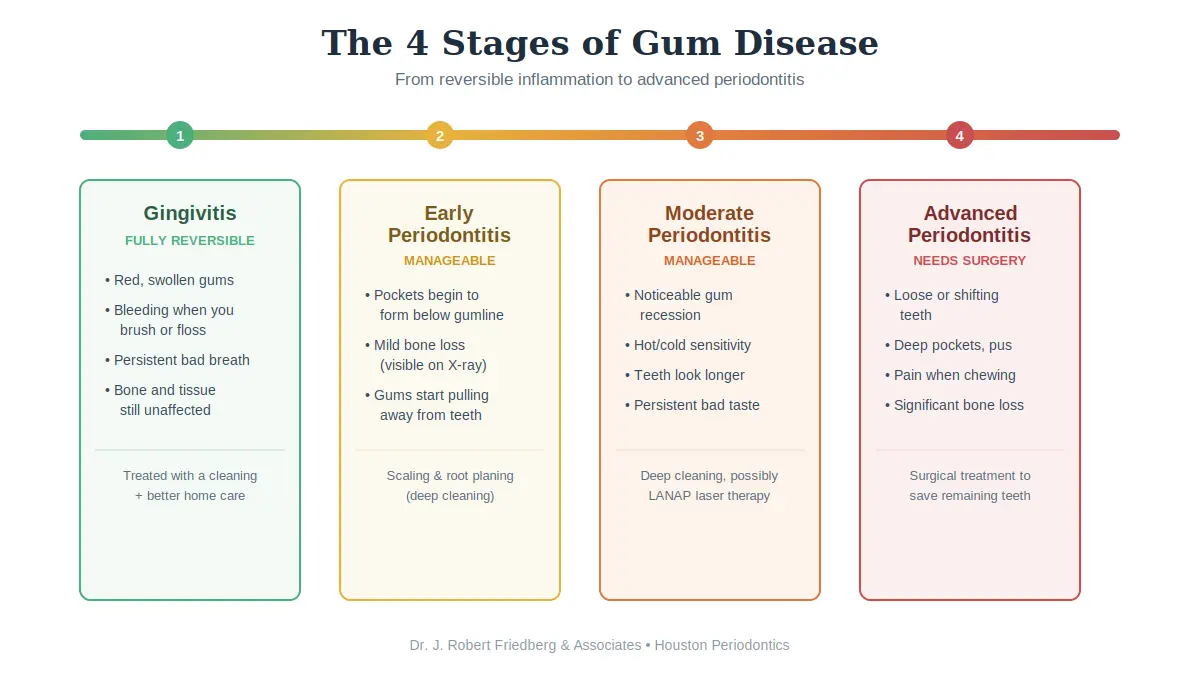
Periodontal disease progresses in four recognized stages. Each one has distinct signs and a different level of urgency.
| Stage | What’s Happening | Reversible? |
|---|---|---|
| Gingivitis | Gum inflammation, occasional bleeding | Yes, fully reversible |
| Early Periodontitis | Pocket formation, early bone loss begins | Manageable, not fully reversible |
| Moderate Periodontitis | Deeper pockets, increased bone loss | Manageable with treatment |
| Advanced Periodontitis | Severe bone loss, loose teeth | Requires surgical intervention |
Stage 1: Gingivitis
Gingivitis is the earliest and mildest of the stages of gum disease, and it’s the only one that’s completely reversible. At this point, plaque buildup along the gumline has caused inflammation, but the damage stays confined to the gum tissue itself — the bone and connective fibers holding your teeth in place remain unaffected.
Common signs of gingivitis include:
- Red or swollen gums
- Gums that bleed during brushing or flossing
- Persistent bad breath
- Mild tenderness
One thing worth noting: gingivitis and even early periodontitis can progress without any pain at all, which is why so many people don’t realize anything is wrong. We cover this in more detail in why gum disease often develops without pain. A professional cleaning and improved home care can typically reverse gingivitis within a few weeks.
Stage 2: Early Periodontitis
If gingivitis goes untreated, the infection begins to move below the gumline. This is the stage where periodontal pockets start to form — small spaces between the tooth and gum where bacteria can hide from your toothbrush and floss. The body’s immune response to this bacteria can begin to break down the connective tissue anchoring your teeth.
At this stage, you may notice:
- Gums that appear to be pulling away from teeth
- Mild bone loss (often only visible on an X-ray)
- Bad breath that doesn’t resolve with brushing
Early periodontitis is no longer reversible in the traditional sense, but treatments like scaling and root planing can effectively manage and halt it.
Stage 3: Moderate Periodontitis
As the disease progresses, bacteria move deeper into the gum tissue and begin to compromise more of the supporting bone. Pockets deepen further, making them harder to clean even with excellent home care. Many patients notice physical changes to their smile at this point in the stages of gum disease.
Symptoms of moderate periodontitis often include:
- Noticeable gum recession
- Increased tooth sensitivity to hot and cold
- Teeth that appear slightly longer as gums recede
- Persistent bad taste or odor
If you’re already noticing gum recession, it’s worth reading about the causes and treatment options for gum recession and whether receding gums can grow back on their own (short answer: not without intervention).
Stage 4: Advanced Periodontitis
Advanced periodontitis is the most severe and destructive of the stages of gum disease. By this point, significant bone loss has occurred, and the disease has substantially damaged the fibers and bone supporting your teeth. Teeth can shift, loosen, or become painful to chew with.
Signs of advanced periodontitis include:
- Visibly loose or shifting teeth
- Deep periodontal pockets
- Pain when chewing
- Pus between teeth and gums
- Changes in how your teeth fit together when you bite
If you’re dealing with a tooth that feels loose, our guide on loose teeth in adults covers what that can mean and when it’s treatable versus when extraction and replacement become necessary. Advanced periodontitis almost always requires surgical treatment to arrest further damage and, where possible, save the remaining teeth.
Signs You Shouldn’t Ignore
Because gum disease can be painless in its early stages, it’s easy to dismiss the warning signs. Here’s a quick checklist of symptoms worth paying attention to, regardless of which of the stages of gum disease they might indicate:
- Bleeding when you brush or floss
- Gums that look red, puffy, or swollen
- Chronic bad breath
- Gums pulling away from your teeth
- Loose or shifting teeth
- Pain when chewing
- Changes in your bite
If any of these sound familiar, it’s worth scheduling an evaluation sooner rather than later. Every stage of gum disease is easier — and less expensive — to treat the earlier a dentist catches it.
How We Treat Gum Disease at Each Stage
Treatment depends heavily on which of the stages of gum disease you’re in:
- Gingivitis: A professional cleaning combined with improved brushing and flossing habits is usually enough to fully reverse it.
- Early to moderate periodontitis: Scaling and root planing (a deep cleaning below the gumline) is the standard treatment, and we sometimes combine it with antimicrobial therapy. Some patients are also candidates for minimally invasive options like the LANAP laser procedure.
- Moderate to advanced periodontitis: Surgical options may be necessary, including gingivectomy or other gum surgery. You can read more about when gum surgery becomes necessary and what it involves.
In every case, the goal is the same: stop the progression, preserve as much natural tooth and bone structure as possible, and prevent tooth loss.
When to See a Periodontist in Houston
If your general dentist has flagged early signs of gum disease, or if you’re noticing any of the symptoms above on your own, it’s worth having a periodontist take a closer look. As Houston’s specialists in gum and bone health, Dr. Friedberg & Associates can pinpoint exactly which of the stages of gum disease you’re at and build a treatment plan that fits it — whether that’s a simple deep cleaning or more advanced periodontal care.
Frequently Asked Questions
Can gum disease be reversed?
Only the first stage, gingivitis, is fully reversible. Once the disease progresses to periodontitis, treatment can stop further damage and manage the condition, but bone or tissue you’ve already lost typically won’t grow back on its own.
How long does it take to move through the stages of gum disease?
It varies widely from person to person depending on oral hygiene, genetics, smoking status, and other health conditions. Some people can stay in the gingivitis stage for years with proper care, while others progress to periodontitis more quickly if the disease goes untreated.
Is gum disease painful?
Not necessarily, especially in its early stages. Many patients experience little to no pain until the disease has progressed significantly, which is part of why regular dental checkups matter even when nothing feels wrong.