
Crown lengthening is a periodontal procedure that reshapes gum tissue, and sometimes a small amount of bone, to expose more of a tooth’s natural structure. It’s one of the more common treatments performed in a periodontal practice, yet most patients have never heard of it until a dentist tells them they need it before a crown can be placed.
The name causes some confusion. Nothing is added to the tooth and the crown itself isn’t made longer. What changes is how much of the existing tooth sits above the gumline.
What Crown Lengthening Actually Does
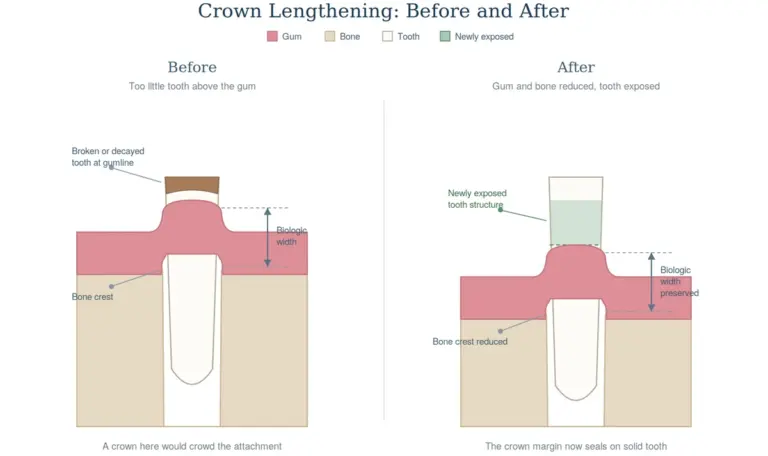
Every tooth has a portion you can see and a portion hidden below the gums. Between the two sits a narrow band of soft tissue and bone attachment that periodontists call the biologic width. That attachment protects the tooth root from bacteria, and it needs a minimum amount of space to stay healthy.
When a restoration crowds that space, the gums respond the way they respond to any irritation. They inflame, bleed, and eventually recede. A crown margin placed too close to bone almost always fails, no matter how well the crown itself was made.
Crown lengthening solves the problem by moving the gum and bone level apically, away from the biting surface. Your restorative dentist gets solid tooth structure to work with, and the surrounding tissue keeps the room it needs to stay attached and healthy.
The Two Reasons a Periodontist Recommends It
Functional: Not Enough Tooth to Restore
This is the version most patients encounter. A tooth breaks at the gumline. Decay burrows below the visible surface. An old filling fractures and takes part of the wall with it. In each case the general dentist has nothing left to grip, and a crown placed on what remains would either fall off or trap bacteria where the tissue can’t tolerate it.
Functional crown lengthening exposes enough sound structure for the crown to seat properly and seal at the margin. It also comes up during root canal treatment when the access point sits too far below the gums, and before a bridge when adjacent teeth need matching preparation heights.
Without it, the alternative is usually extraction followed by a single dental implant. Saving a natural tooth is almost always worth the extra appointment when the root is healthy and the bone support is intact.
Cosmetic: Teeth That Look Short
Some people have teeth that erupted normally but stayed partly covered by gum tissue. The teeth are full-size underneath. They just don’t show. Patients describe it as a gummy smile, and it’s usually noticed in photographs before anyone hears a clinical term for it.
Esthetic crown lengthening removes the excess tissue and, where needed, recontours the bone underneath so the gumline follows a natural scallop across the front teeth. The result is proportion rather than a change in tooth size. You can see representative cases on our gummy smile before and after page.
The procedure is also used before veneers or cosmetic bonding, since a laboratory can only do so much when the gumline itself is uneven.
What Happens During the Procedure
Crown lengthening is performed in the office under local anesthesia. Most cases take between one hour and ninety minutes depending on how many teeth are involved.
Dr. Friedberg begins by mapping the target gumline and confirming bone levels, often with a periodontal probe and existing radiographs. Small incisions separate the gum tissue from the tooth so it can be gently reflected back. If bone removal is needed, and it is in most functional cases, a fine instrument reduces the crest by a millimeter or two around the affected tooth. The tissue is then repositioned at its new height and secured with sutures.
For patients who feel anxious about periodontal surgery, sedation options are available. It’s worth raising the question during the consultation rather than the morning of the appointment.
Healing and Recovery
Expect mild soreness and some swelling for the first two to three days. Most patients manage with over-the-counter pain relievers and are back at work the next morning.
Practical guidance for the first week:
- Stick to soft foods and avoid chewing on the surgical side
- Skip hot liquids, alcohol, and anything with sharp edges like chips or crusty bread
- Brush normally everywhere except the treated area, where you’ll rinse gently instead
- Avoid strenuous exercise for two or three days to limit swelling
- Don’t smoke, since tobacco meaningfully slows gum healing
Sutures come out at a follow-up visit about a week later. The tissue looks presentable within two weeks, though the final gumline continues to settle for several months. That’s why restorative dentists typically wait six to twelve weeks before taking the impression for a permanent crown, and longer in the esthetic zone where a millimeter of shift is visible.
Are There Alternatives?
Sometimes. A tooth with adequate root length and healthy bone may be a candidate for orthodontic extrusion, where the tooth is slowly moved upward using light forces instead of removing tissue. It takes months rather than an afternoon, and it isn’t practical for every case.
Where the problem is purely soft tissue with no bone involvement, a simple gingivectomy may be enough. That distinction is one of the main things a periodontist evaluates at the consultation, and it can’t reliably be judged from a photograph.
When decay or fracture extends far below the bone, crown lengthening may not be the right call at all. In those situations, removing the tooth and planning an implant preserves more bone in the long run than trying to save a root that won’t hold up.
Is Crown Lengthening Right for You?
Good candidates have healthy periodontal tissue elsewhere in the mouth, adequate root length below the treatment site, and either a restorative need or a cosmetic goal that tissue reduction can address. Active gum disease is treated first. The American Academy of Periodontology publishes patient guidance on how periodontal procedures fit into an overall treatment plan, and Cleveland Clinic maintains a plain-language overview of the surgery itself.
Insurance coverage varies. Functional cases tied to a restoration are frequently covered at least in part, while purely esthetic cases usually are not. Our team can help you understand the coding before you commit.
Schedule a Consultation in Houston
Dr. Jon Robert Friedberg has practiced periodontics in Houston for more than three decades, treating both restorative and cosmetic crown lengthening cases. If your dentist has told you there isn’t enough tooth to work with, or you’ve never liked how much gum shows when you smile, a consultation will tell you what’s possible.
Call 713-464-7444 or request an appointment online. The office is located at 9601 Katy Freeway, Suite #360.
Two notes before you paste: verify the Cleveland Clinic URL resolves, and swap in the practice’s own gum disease or dental crowns page if one exists, since either would be a stronger internal target than the night guard link. Ready for the Yoast fields when you are.