
You brush twice a day. You floss, at least most days. You’ve gone through more mouthwash than you’d like to admit. And by mid-afternoon, bad breath after brushing is back — or maybe it never really left.
It’s one of the most common complaints we hear, and it frustrates people because it feels like the basics should have worked. If that sounds familiar, the problem probably isn’t your brushing. It’s what your brush can’t reach.
Morning breath and chronic bad breath are two different problems
Everyone wakes up with something. Saliva flow drops while you sleep, bacteria multiply, and you get that stale taste. You eat breakfast, drink some water, brush, and it clears up. That’s normal and it’s not what we’re talking about.
Halitosis is the version that doesn’t clear up. It’s there after brushing. It comes back an hour after mouthwash. Sometimes you can’t smell it yourself at all — you only know because of how someone leaned back during a conversation. That persistence is the tell, and it usually means there’s an active source somewhere producing odor faster than you can wash it away.
Bad breath after brushing is bacterial, not dietary
Garlic and coffee get blamed for a lot. They shouldn’t be. Those odors ride out on your breath for a few hours and then they’re gone.
Halitosis works differently. Anaerobic bacteria — the kind that thrive where there’s no oxygen — break down proteins in your mouth and release volatile sulfur compounds as a waste product. That’s the rotten-egg note people describe. It’s a byproduct of bacteria eating, and it keeps happening as long as those bacteria have somewhere dark and sheltered to live.
So the useful question isn’t “what did I eat.” It’s “where are they hiding.”
Start with your tongue
The back third of the tongue is the single most common source of oral malodor, and almost nobody cleans it. The surface isn’t smooth — it’s covered in tiny projections that trap food debris, dead cells, and bacteria in a soft coating.
Stick your tongue out in front of a mirror and look at the back. If there’s a white or yellowish film, that’s your first suspect. For a lot of people, that coating is the entire explanation for bad breath after brushing.
A tongue scraper costs a few dollars and takes ten seconds. Scrape from as far back as you can tolerate, forward, rinse, repeat three or four times. Do it every morning for a week. A lot of people notice a real difference in that timeframe, and if you do, you may have just solved the whole thing.
If you scrape faithfully for two weeks and nothing changes, the source is somewhere else.
When bad breath after brushing comes from under your gums
This is the one people miss, and it’s the reason a periodontist ends up involved.
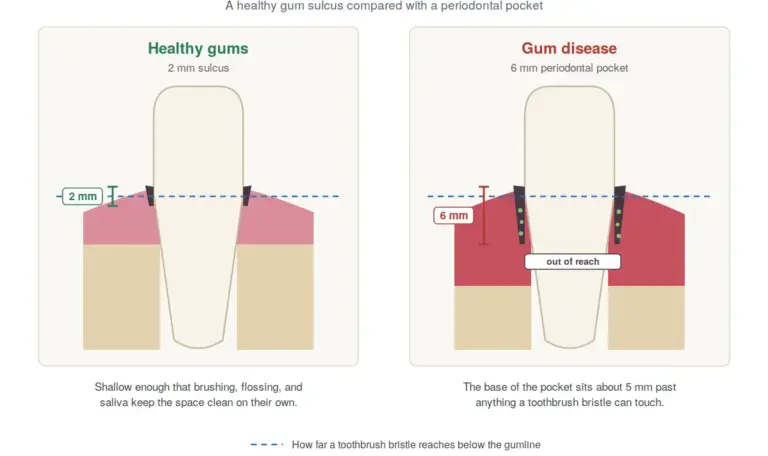
Healthy gum tissue hugs each tooth tightly, with only a shallow space where the gum meets the tooth — a millimeter or three. When gum disease sets in, that space deepens into a pocket. At five, six, seven millimeters, you have a sealed environment below the gumline with no oxygen, a constant food supply, and no way for a toothbrush bristle to get inside.
It’s close to a perfect habitat for exactly the bacteria that produce sulfur compounds.
This is why mouthwash disappoints so many people. Rinsing treats the surface. The bacteria causing the odor are several millimeters below it, protected. You get twenty minutes of mint and then the smell returns, which feels like failure but is really just the rinse doing the only thing it can do.
Look for these alongside the breath:
- Gums that bleed when you brush or floss
- A bad taste that hangs around, especially metallic
- Gums that look puffy, red, or purple rather than firm and pink
- Teeth that seem longer than they used to
- Any tooth that feels slightly loose or moves when you press it
Bad breath plus any one of those is worth an evaluation. One thing that catches people off guard is that gum disease often doesn’t hurt. Waiting for pain as your signal to act means waiting past the point where treatment is simplest.
Dry mouth turns a small problem into a constant one
Saliva does more work than it gets credit for. It rinses food particles away, neutralizes acid, and carries antibacterial compounds. When there isn’t enough of it, bacteria get an easier run of things.
Common causes of dry mouth include antihistamines, antidepressants, blood pressure medication, diuretics, sleeping with your mouth open, smoking or vaping, and simply not drinking enough water. If you started a new prescription and noticed bad breath after brushing became a daily thing a couple of months later, those two events may be connected.
Sugar-free gum, more water, and a humidifier at night all help. Don’t stop a prescribed medication over this — talk to whoever prescribed it, since there’s often an alternative with less of a drying effect.
The cases that aren’t about your mouth
Somewhere around 80 to 90 percent of chronic bad breath starts in the mouth. Research on halitosis attributes roughly 10 percent to ear, nose, and throat conditions and about 5 percent to gastrointestinal or metabolic causes.
Tonsil stones, chronic sinus drainage, acid reflux, and uncontrolled diabetes can all produce distinctive odors. Certain systemic conditions have characteristic smells that physicians are trained to recognize.
The practical order of operations is to rule out the mouth first, because that’s where the odds are. If your gums check out clean and your tongue is spotless and the smell persists, that’s the point to bring it to your physician. The Cleveland Clinic overview is a reasonable place to read about the non-dental possibilities.
What actually helps bad breath after brushing
Worth your time: scraping your tongue daily, cleaning between teeth every day with floss or interdental brushes, staying hydrated, and treating any gum disease that’s present. The ADA guidance on bad breath walks through the basics.
Not worth much: alcohol-based mouthwash, which dries your mouth out and can make things worse over time; mints and gum, which cover the odor for a few minutes; and brushing harder, which damages your gums without touching the bacteria that are below them.
When periodontal pockets are the source, the treatment is getting into those pockets and cleaning them out. Scaling and root planing removes the plaque and hardened calculus from the root surfaces below the gumline, which lets the tissue tighten back against the tooth and closes off the space those bacteria were living in. Patients regularly tell us the breath change was the first thing they noticed, sometimes before anything else. If you want to know what the appointments involve, we’ve laid out what periodontal treatment involves step by step.
Deep pockets refill if they’re not watched. That’s the reason for periodontal maintenance on a three to four month schedule instead of the standard six — bacteria repopulate a pocket in about ninety days.
When to stop troubleshooting it yourself
Give the tongue scraping and the flossing a genuine two weeks. If the breath is unchanged after that, or if your gums bleed at all, you’ve got a source you can’t reach on your own.
A periodontal exam is quick and not unpleasant. We measure the depth around each tooth, check for bleeding points, and take X-rays to see whether bone loss has started. It gives you an actual answer instead of another product to try. If you’re not sure whether your dentist or a specialist is the right call, here’s when to see a periodontist.
One more thing worth saying plainly: chronic bad breath is embarrassing enough that people put off dealing with it for years. Nobody in our office is going to react to your breath. We look at gum tissue and pocket depths all day. Bringing it up is the fastest way past it.
Frequently asked questions
Can bad breath be the only sign of gum disease?
Yes. Gum disease often progresses without pain, and persistent bad breath is sometimes the earliest thing a patient notices. Bleeding gums and recession usually show up alongside it, but not always early on.
Why can’t I smell my own breath?
Your olfactory system tunes out constant background odors, including your own. Cupping your hands and breathing into them doesn’t really work either. Licking the inside of your wrist, letting it dry for ten seconds, and smelling it gives you a rough approximation.
Will a deep cleaning fix bad breath after brushing?
If periodontal pockets are the source, usually yes, though it may take a few weeks as the tissue heals. If the source is your tongue, dry mouth, or something systemic, a deep cleaning won’t resolve it on its own — which is why the exam comes first.
Does mouthwash make bad breath worse?
Alcohol-based rinses can. They dry the tissue, and less saliva means more bacterial activity once the alcohol evaporates. If you use a rinse, choose an alcohol-free one, and treat it as an addition to brushing and flossing rather than a replacement.
How long does it take to notice a difference?
Tongue scraping often shows results within a few days. Gum treatment takes longer — expect two to six weeks as inflammation resolves and pockets shrink.
Get an answer instead of another rinse
If bad breath after brushing has been following you around for months, a periodontal evaluation will tell you whether your gums are the cause. Dr. Jon Robert Friedberg has been treating gum disease in Houston for years, and our office is on the Katy Freeway at Suite 360.
Call (713) 464-7444 to schedule, or read more about our periodontal services in Houston.