
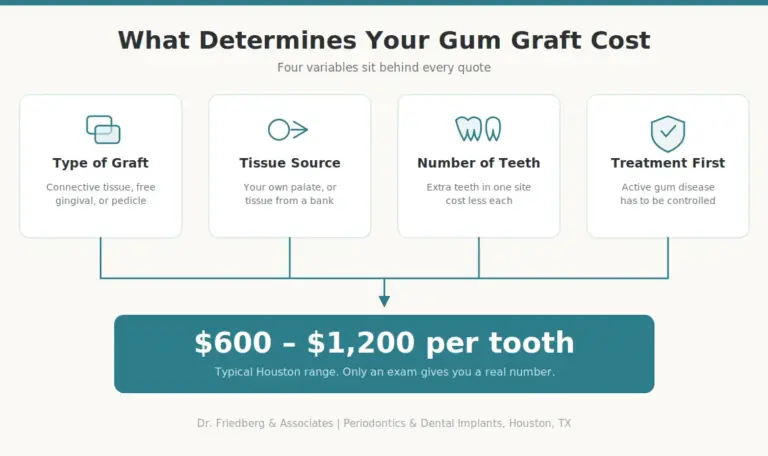
If your dentist just told you that you need a gum graft, the first thing you want to know is the number. Nobody leads with “tell me about the sutures.” They want the price. The honest answer: gum graft cost in Houston usually lands between $600 and $1,200 per tooth, and the spread inside that range comes down to a handful of specific things — how many teeth are involved, where the tissue comes from, and whether anything else needs to happen first.
Below is a plain breakdown of what you actually pay for, what insurance tends to cover, and how to judge whether a quote you have in hand looks reasonable.
Gum Graft Cost at a Glance
Offices quote fees per tooth, not per mouth. That surprises people. If recession affects three teeth in the same area, you generally pay full price on the first tooth and a reduced rate on the neighbors, since the surgeon treats them all in one sitting.
| What you pay for | Typical range |
|---|---|
| Gum graft, single tooth | $600 to $1,200 |
| Additional teeth in the same site | Usually less per tooth |
| Consultation, exam and imaging | Often a separate fee |
| Sedation, if you want it | Adds to the total |
Those are general Houston ranges, not a quote. The only number that means anything is the one you get after an exam, because a periodontist has to measure the recession and look at the bone underneath before anyone can price it honestly.
What Drives Gum Graft Cost Up or Down
The type of graft
There are a few ways to rebuild a gumline, and they do not all cost the same. A connective tissue graft, the most common approach, takes tissue from under the surface of your palate and tucks it over the exposed root. A free gingival graft takes surface tissue instead and suits patients whose gums run thin rather than badly receded. A pedicle graft borrows healthy tissue from right next to the problem area. Our gum grafting page walks through how each one works and who it suits.
Where the tissue comes from
Some cases use donor tissue from a tissue bank instead of your own palate. That spares you a second surgical site and makes recovery much easier, but the material itself carries a cost. It often pays for itself if you are treating several teeth at once and would rather not spend two weeks with a healing palate.
How many teeth need treating
One tooth is a straightforward appointment. Six teeth across two quadrants is a different conversation, both surgically and financially. This is also why catching recession early saves real money.
What else is going on in your mouth
When active gum disease caused the recession, we have to control the infection before grafting. Placing new tissue into an infected site wastes everyone’s time and your money. That may mean scaling and root planing first, which carries its own fee. If you are not sure where you stand, our guide to the stages of gum disease is a useful starting point.
Does Insurance Cover the Cost of Gum Grafting?
Often, yes, at least partially. Most plans treat a gum graft as a medically necessary periodontal procedure when there is documented recession, root exposure, or attachment loss. Coverage typically falls somewhere around 50 to 80 percent of the allowed amount, depending on your plan tier and whether you have met your deductible.
Where people get caught out:
- Annual maximums. Many plans cap out around $1,500 to $2,000 a year. If you already spent benefits on other work, there may not be much left.
- Cosmetic exclusions. If you want the graft purely to even out a gumline with no functional problem, plans will often decline it.
- Waiting periods. Newer policies frequently make you wait six to twelve months before they cover major services.
- Pre-authorization. Ask for a predetermination before treatment and the plan tells you in writing what it will pay. It takes a couple of weeks and removes the guesswork.
Ask our front desk for the specific procedure codes and the narrative that goes out with your claim. Those two things do most of the work in winning approval, and any good periodontal office hands them over without hesitation.
Covering Gum Grafting Cost Without Insurance
Plenty of patients pay out of pocket. A few practical options:
- Third-party financing such as CareCredit, which spreads the cost over monthly payments, often with a promotional interest-free window.
- HSA or FSA dollars. A gum graft counts as a qualified medical expense, so pre-tax money applies.
- Phasing treatment. If several areas need work, treat the most at-risk teeth first and schedule the rest later. That is a legitimate approach, not a compromise.
The Cost of Waiting
This part rarely makes it into the money conversation. Exposed roots have no enamel on them. They decay faster, they react to hot and cold, and the recession does not reverse on its own no matter what a toothpaste ad implies. We covered that in detail in do receding gums grow back.
Leave it long enough and recession leads to root decay, bone loss, and eventually a loose tooth. Replacing a single tooth with an implant runs several thousand dollars. Against that, a gum graft cost of $600 to $1,200 starts to look less like an expense and more like the cheaper branch of the decision tree. You can compare grafting with other periodontal work on our periodontist cost overview.
Are There Cheaper Alternatives to a Gum Graft?
Sometimes, and it depends entirely on what caused the recession.
The Pinhole Surgical Technique treats recession without scalpels or sutures by repositioning your existing gum tissue through a tiny entry point. Because there is no donor site, you heal faster, and a periodontist can often handle several teeth in one visit. The gum graft price is not automatically lower, but across multiple adjacent teeth it can work out well. It also needs enough healthy tissue to reposition, so it does not suit everyone.
For mild recession with no root exposure, the answer might be no surgery at all. A softer brush, a corrected technique, a night guard for grinding, and monitoring at each cleaning may be enough. A periodontist should tell you that when it is true. If you are weighing whether