
Losing one tooth raises a lot of questions fast. If you’re researching a single dental implant in Houston, here’s the honest version of what’s ahead. It isn’t one appointment — it’s a multi-month process. You’ll move through planning, placement surgery, a healing period, and finally the crown.
Most straightforward cases take 3 to 5 months and cost $3,000 to $6,000 in Houston. This guide walks through every stage so nothing on your treatment plan surprises you.
What a Single Dental Implant Replaces
A single dental implant restores one missing tooth with three parts. A titanium post goes into the jawbone. An abutment screws into that post. A custom crown sits on top — that’s the part you see. The post does the job your natural root used to do.
That’s the main advantage over a traditional bridge. A bridge borrows support from the teeth on either side, which usually means grinding down healthy enamel. An implant stands alone, and the neighbors are left untouched.
Most healthy adults in Houston are candidates for a single dental implant. What matters is gum health, bone volume, medical history, and where the gap sits. If the tooth still needs extraction or the site needs a bone graft, plan on a longer road. Grafted cases often take 9 to 12 months before placement, versus 3 to 5 months for standard ones. The American Academy of Implant Dentistry has a good plain-English overview of candidacy.
Step 1: Consultation and Treatment Planning in Houston
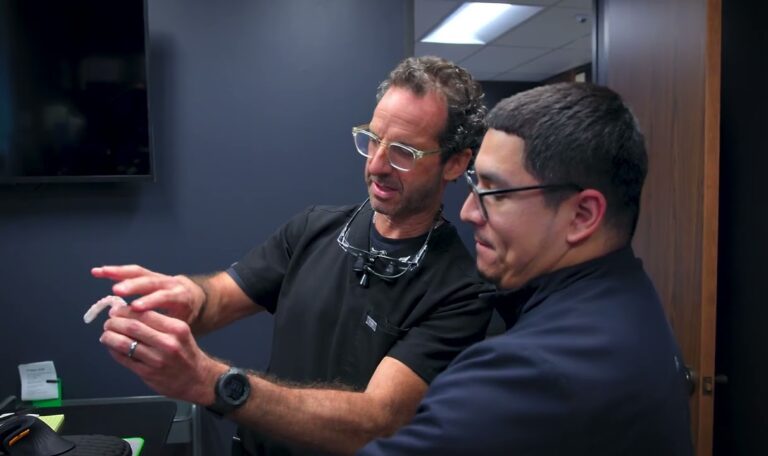
The first visit is mostly detective work. The dentist reviews your medical history and medications, checks for gum disease, and looks at your bite. You’ll get X-rays — usually a 3D cone-beam scan. That scan shows how much bone is available. It also keeps the implant clear of nerves and sinus spaces.
Houston has hundreds of providers offering single dental implant treatment, so use this visit to interview the office. Three questions worth asking outright:
Who performs each stage? Some Houston general dentists place implants themselves. Others refer the surgery to a periodontist or oral surgeon and handle only the crown. Neither model is automatically better, but you should know who’s holding the drill. You can verify any Texas dentist’s license through the Texas State Board of Dental Examiners.
How many implants do you place a year? Volume isn’t everything. Still, it’s a fair question, and a confident office won’t flinch at it.
What exactly does the quote include? A real estimate itemizes imaging, prep work, surgery, the abutment, and the crown separately. One vague “implant” line item is a red flag.
When Prep Work Comes First
Some patients need an extraction, gum treatment, or bone grafting before placement. These aren’t automatic add-ons. The recommendation should follow from your scan and exam, not a standard package. If grafting appears on your plan, ask the dentist to show you the spot on your imaging that justifies it. The American Academy of Periodontology explains when grafting is genuinely indicated.
Step 2: Single Dental Implant Placement Day
The surgery is shorter than most people expect — often under an hour for one site. The area is numbed. A small channel is prepared in the bone, and the post is placed. Local anesthesia handles the pain. Sedation is optional and mostly manages anxiety. If you choose sedation, arrange a ride home.
Will you leave with a temporary tooth? Sometimes. It depends on how firmly the implant seats at placement. Clinicians measure this as insertion torque (roughly 32–35 Ncm or higher) or an ISQ stability reading above 60–65. If the implant is stable enough, you may get a temporary kept out of your bite. If not, the site heals uncovered. Protecting a new implant matters more than filling the gap for a few months.
Before the visit, stock the fridge with soft foods and grab an ice pack. Clear your calendar for a quiet day or two.
Step 3: Healing and Osseointegration
Osseointegration is the part you can’t rush. Bone slowly grows onto the implant surface and locks it in place. Lower jaw sites typically need 3 to 4 months. Upper jaw sites have softer bone and usually need 4 to 6. Your timeline is set by your biology, not by anything you read online — this article included.
Recovery from the surgery itself is much shorter. Soreness usually runs 3 to 5 days. Swelling peaks around day 2 or 3 and settles within 7 to 10 days. Light bleeding rarely lasts past the first 48 hours. Follow the written aftercare sheet on cleaning, eating, and medications.
Call the office if symptoms are severe, worsening, or simply off-script. Nobody can diagnose a complication over Google. Dental offices genuinely prefer an unnecessary phone call to a delayed one.
Step 4: Abutment and Final Crown
Once the implant is solid, the abutment — the connector piece — goes on. The office takes digital impressions or a mold. A lab builds a crown matched to your bite and the color of neighboring teeth.
At delivery, the dentist checks the fit, the contacts, and how it feels when you close down. Speak up if anything feels high or chewing feels uneven. That’s a quick adjustment, not a complaint. Don’t wait it out — a crown that hits early takes force it wasn’t designed for.
One thing that surprises people: an implant crown can’t get a cavity, but the gums around it can still get into trouble. Plaque causes peri-implant disease the same way it causes gum disease around natural teeth. Daily cleaning and regular checkups stay on the schedule for life.
Recovery, Daily Care, and Long-Term Follow-Up
Early on, expect soft-food guidance and a temporary ban on chewing at the site. How strict and how long depends on your case, so follow your clinician’s instructions over any general rule.
One risk factor deserves blunt language. Smoking roughly doubles the odds of implant failure — pooled research puts the odds ratio around 2.4 versus non-smokers. If you smoke or vape, tell your dental team the truth. It changes how they plan and monitor your case. The National Institute of Dental and Craniofacial Research publishes accessible research on oral health risk factors.
Two mistakes to avoid: skipping follow-ups because everything “feels fine,” and going back to popcorn and brisket before you’re cleared. And don’t borrow someone else’s price or timeline from a Houston Reddit thread. Bone quality and case complexity make every plan different.
Single Dental Implant Cost in Houston (2026)
In 2026, a single dental implant in Houston — post, abutment, and crown together — typically costs $3,000 to $6,000. Most cases land around $3,500 to $4,750. Houston pricing runs at or slightly below national averages. Expect real variation between a Galleria-area specialty practice and a suburban general office. The spread reflects the surgeon’s training, the implant brand, the lab work, and any grafting or extraction on the plan.
A few Houston-specific ways to manage the cost:
Dental school clinics. The UTHealth Houston School of Dentistry offers implant treatment through supervised student and resident clinics at a significant discount. The trade-off is longer appointments and a slower schedule.
Insurance and financing. Many dental plans still classify implants as elective, but coverage has improved. Some now contribute toward the crown even if they exclude the surgery. Verify benefits with both your insurer and the office before signing anything. If financing is offered, read the interest rate, fees, and refund terms first. The ADA’s consumer site has neutral guidance on paying for dental care.
Get the plan in writing. Ask for an itemized document separating imaging, prep work, grafting, surgery, abutment, crown, and follow-up. Ask whether future bite adjustments or replacement parts cost extra. When you’re ready for a case-specific quote, request a consultation.
Frequently Asked Questions
How long does a single dental implant take in Houston?
The placement surgery usually takes under an hour. The full process — consult to final crown — runs about 3 to 5 months in straightforward cases. Add extraction and grafting, and it stretches to 9 to 12 months. Only an exam can pin down your number.
What is the “3-2 rule” for implants?
There’s no universally accepted 3-2 rule. Different providers use the phrase for different measurements, often spacing between an implant and adjacent teeth. If it shows up in your plan, ask your dentist to define exactly what the numbers mean in your case.
How painful is getting one dental implant?
The placement itself is numb. Most people describe recovery as sore rather than painful — a few days of tenderness and swelling, managed with medication. Your office should tell you which symptoms are normal and which warrant a call.
What should I know before saying yes?
Know who performs the surgery and why an implant beats a bridge for your gap. Get the itemized cost, the healing timeline, and the maintenance plan. And give your dentist a complete medical history — medications and conditions like diabetes genuinely change implant planning.
Getting a single dental implant in Houston comes down to careful diagnosis, precise placement, patient healing, and a well-fitted crown. After that, it’s ordinary, boring maintenance for years. The best next step isn’t more reading. It’s a written, case-specific plan from a licensed Houston provider you’ve actually vetted.