
If your doctor diagnosed you with obstructive sleep apnea and CPAP didn’t stick, a mandibular advancement device is usually the next thing someone mentions. It goes by a lot of names in casual conversation. Sleep apnea mouth guard. Oral appliance. Snore guard. They’re all describing roughly the same idea: a custom-fitted device you wear at night that holds your lower jaw slightly forward.
That small change in jaw position is doing more work than it sounds like.
What a mandibular advancement device actually does
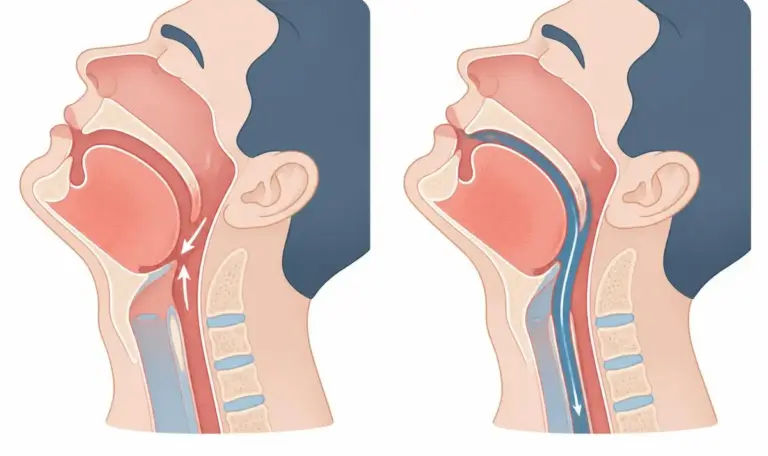
When you fall asleep, the muscles in your throat relax. In people with obstructive sleep apnea, the tongue and soft tissue at the back of the throat collapse backward far enough to block airflow. You stop breathing, your brain partially wakes you to restart the cycle, and this repeats dozens of times an hour without you remembering any of it.
A mandibular advancement device works by repositioning the lower jaw forward, which pulls the base of the tongue and the surrounding soft tissue forward with it. That opens up space in the airway. More room means less collapse.
The device itself looks like two thin trays, one for the upper teeth and one for the lower, connected by a mechanism that sets how far forward the lower jaw sits. It’s fitted to impressions of your own teeth, so it’s not interchangeable with anything you’d buy off a shelf. A boil-and-bite guard from a drugstore can’t hold a jaw position accurately, and it can move teeth in ways nobody planned for.
For a fuller look at the treatment itself, our treatment page covers the clinical side in more detail.
Who a mandibular advancement device works for
Oral appliance therapy is best supported for people with mild to moderate obstructive sleep apnea. It’s also recommended for people with severe apnea who’ve tried CPAP and can’t tolerate it, which describes a lot of the patients who end up in our chair. The American Academy of Dental Sleep Medicine treats an appliance you’ll actually wear as a better outcome than a machine sitting unused in a closet.
A few things determine whether you’re a good candidate:
You need enough healthy teeth to anchor the device. The appliance grips your teeth and applies gentle forward pressure to your jaw every night. If you have advanced gum disease or significant bone loss, that foundation has to be stabilized first. This is where seeing a periodontist matters, because we’re evaluating the health of the supporting structures, not just taking impressions.
Your jaw joint needs to tolerate the position. If you have significant TMJ problems, we’ll talk through that before moving forward.
You need a diagnosis. A dentist can’t diagnose sleep apnea. That comes from a sleep study ordered and read by a physician. If you haven’t gotten that far yet, our post on snoring vs sleep apnea walks through the difference and when to push for testing.
What the first few weeks feel like
Nobody sleeps perfectly the first night. That’s worth saying out loud, because people sometimes decide the device failed after two nights.
Expect some soreness in your teeth and jaw when you wake up, usually fading within an hour. Extra saliva is common early on, and so is the opposite, a dry mouth. Most of this settles within two to four weeks as your muscles adapt to the new position.
The Mayo Clinic lists oral appliances among the standard treatment options for obstructive sleep apnea, and the adjustment period is a normal part of that process rather than a sign something’s wrong.
What shouldn’t happen is sharp joint pain, a bite that feels noticeably off during the day, or teeth that feel loose. Call us if any of that shows up.
Adjustments matter more than the device
This is the part people underestimate. A mandibular advancement device isn’t a one-appointment product. It’s a treatment you calibrate over time.
At delivery, the jaw sits at a conservative starting position. Over the following weeks and months, we advance it in small increments based on how you’re sleeping, whether your partner still hears snoring, and how your jaw is tolerating it. Push too far too fast and you get joint soreness for no added benefit. Not far enough and the airway doesn’t open enough to help.
Follow-up visits are also where we check what the device is doing to your bite and your gum tissue. Long-term appliance wear can shift teeth slightly in some patients, and catching that early is straightforward. Ignoring it for years is not.
Once you’ve settled into a position that works, your physician may want a follow-up sleep study to confirm the appliance is actually controlling the apnea, not just the snoring. Those two things aren’t the same, and quieter nights don’t automatically mean treated nights.
If you want the step-by-step version of the whole process, from sleep study to final fitting, we covered it in this walkthrough.
Taking care of it
Rinse it and brush it with a soft brush every morning, using plain water or a mild non-abrasive cleaner. Toothpaste is more abrasive than most people realize and will dull the surface over time. Let it dry fully before storing it in its case, and keep it away from heat, since a hot car will warp the acrylic.
Bring it to every dental visit. We check the fit, the hardware, and the wear at the same time we’re checking your teeth and gums.
With reasonable care, most devices last several years before they need replacing. Grinding wears them faster.
Talk to a Houston periodontist about a mandibular advancement device
If CPAP hasn’t worked for you, or you’ve been diagnosed and want to know whether an oral appliance is realistic in your case, we can evaluate it. Dr. Jon Robert Friedberg is a board-certified periodontist, and the evaluation covers both the airway question and the health of the teeth and gums that have to support the device.
Frequently asked questions about mandibular advancement devices
Does a mandibular advancement device work as well as CPAP?
CPAP controls apnea more completely when it’s worn all night, every night. The catch is that a lot of people don’t wear it that way. Because most people stick with an oral appliance more consistently, the real-world results often end up closer than the raw numbers suggest. For mild to moderate apnea, an appliance is a well-supported option on its own.
How long does it take to get used to wearing one?
Most people adapt within two to four weeks. Early on you may notice morning jaw soreness, extra saliva, or a dry mouth. Those usually fade as the muscles adjust. Give it more than a couple of nights before deciding it isn’t working.
Will a mandibular advancement device move my teeth?
It can, in some patients, over years of wear. Small bite changes are the most common effect. This is one reason follow-up visits matter, since catching a shift early is simple to manage and ignoring it for a decade is not.
Can I get one if I have gum disease?
Not until the gum disease is treated and stable. The device anchors to your teeth and puts gentle pressure on them every night, so the supporting bone and tissue have to be healthy first. That evaluation is part of what a periodontist does before fitting anything.
Do I still need a sleep study?
Yes. A dentist can’t diagnose sleep apnea. You need a sleep study ordered and interpreted by a physician before an appliance is appropriate, and your physician may want a follow-up study afterward to confirm the device is actually controlling the apnea.
Call (713) 464-7444 or request an appointment online. We’re at 9601 Katy Freeway, Suite #360, in Houston.