
A lot of patients assume vaping is a free pass for their mouth. Cigarettes stain teeth and cause gum disease, the thinking goes, but vapor is just flavored mist. Unfortunately, that’s not what the research shows. Does vaping cause gum disease? The honest answer is that vaping and gum disease are closely linked, and in some ways vaping makes periodontal problems harder to catch early. Here’s what we know, what’s still being studied, and what we recommend if you vape.
The Short Answer
Vaping has not been studied as long as cigarette smoking, so the evidence base is younger. But the studies we do have point in one direction. Regular e-cigarette users develop gum disease at higher rates than people who don’t smoke or vape, show measurable changes in the bacteria living below the gumline, and tend to respond less predictably to periodontal treatment.
Is vaping as bad for your gums as smoking? Probably not. Is it safe for your gums? No, and treating it as harmless is where many vapers get into trouble.
How Vaping Affects Your Gums
Nicotine restricts blood flow
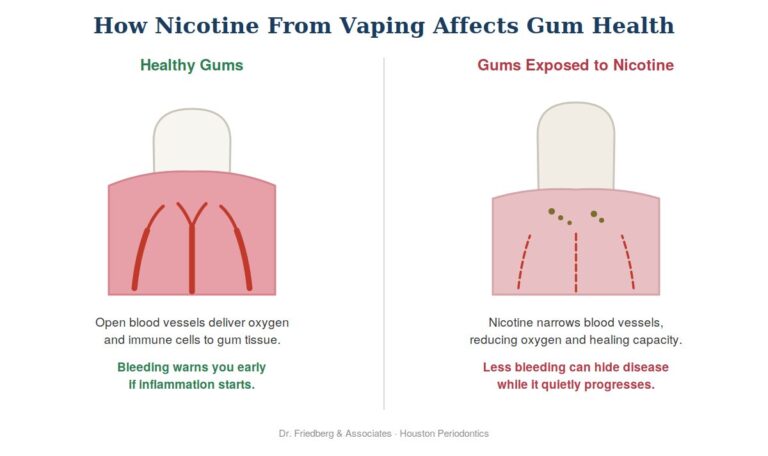
Most e-liquids contain nicotine, and many disposable vapes deliver it at very high concentrations. Nicotine is a vasoconstrictor. It narrows the small blood vessels in your gum tissue, which reduces the oxygen and nutrients your gums need to fight infection and heal. This is the same mechanism that makes smoking so destructive to periodontal health, and it applies whether the nicotine arrives in smoke or in vapor.
Vaping changes the bacteria in your mouth
Gum disease is driven by bacterial biofilm, so anything that shifts the balance of bacteria in your mouth matters. A series of studies from NYU College of Dentistry found that e-cigarette users carry a distinct oral microbiome that sits somewhere between non-smokers and cigarette smokers, with higher levels of the bacteria most closely linked to periodontitis. In their longitudinal research, gum disease measurements worsened in e-cigarette users over just six months of follow-up.
The aerosol itself irritates and dries oral tissue
Vape aerosol is not just water. Propylene glycol and vegetable glycerin, the base of most e-liquids, pull moisture from oral tissue and contribute to dry mouth. Saliva is one of your mouth’s main defenses against bacterial buildup, so chronic dryness gives plaque an easier environment to thrive in. Laboratory research has also shown that e-liquid components and flavoring chemicals trigger inflammatory responses in gum cells directly.
The Masking Problem: Why a Vaper’s Gums Can Look Healthy
This is the part we most want vapers to understand. Because nicotine restricts blood flow, gums often bleed less in people who vape, even when disease is active underneath. Bleeding during brushing is the warning sign most people rely on. Take that signal away and gum disease can progress quietly for years.
We see a version of this in longtime smokers all the time: gums that look pale and firm on the surface while probing and X-rays reveal deep pockets and bone loss. Vaping can create the same false sense of security. If you vape and your gums never bleed, that is not proof of health. It may simply mean your early warning system is switched off. This is one reason gum disease without pain or obvious symptoms is so common, and why regular periodontal exams with probing measurements matter more for vapers, not less.
Vaping and Gum Disease: What Studies Show
A few findings are worth knowing specifically:
- Higher rates of new gum disease. An analysis of the national Population Assessment of Tobacco and Health (PATH) survey found that regular users of electronic nicotine products had about 76% higher odds of receiving a new gum disease diagnosis compared with people who never used them.
- Prevalence sits between non-users and smokers. A study published in the journal iScience found gum disease and oral infection in roughly 43% of e-cigarette users, compared with about 28% of people who neither smoked nor vaped and 73% of cigarette smokers.
- More attachment loss and worse treatment response. A 2024 scoping review of 23 clinical studies concluded that vaping is associated with greater clinical attachment loss than in non-smokers, unfavorable shifts in periodontal bacteria and inflammatory markers, and a less favorable response to periodontal therapy.
Researchers are careful to note that long-term, high-quality data is still limited because vaping is a relatively new habit. But “we don’t have 30-year studies yet” is very different from “vaping is safe for your gums.”
Is Vaping Safer for Your Gums Than Smoking?
Based on current evidence, e-cigarette users generally show less periodontal damage than cigarette smokers, and vapor spares you the combustion byproducts of burning tobacco. If a longtime smoker uses vaping strictly as a stepping stone to quitting nicotine entirely, their gums are likely better off than if they had kept smoking.
The problem is that most vaping doesn’t work that way in practice. Many people vape more frequently than they ever smoked, because there’s no natural stopping point like finishing a cigarette, and modern devices deliver nicotine efficiently all day long. Steady, high-dose nicotine exposure is exactly what gum tissue doesn’t need. So while vaping may be the lesser of two evils, we’d caution any patient against switching from cigarettes to vaping and assuming their periodontal risk is behind them.
Vaping, Healing, and Dental Implants
Nicotine’s effect on blood flow doesn’t just raise the risk of developing gum disease. It also interferes with healing after treatment. Studies included in the reviews above found that e-cigarette users respond less predictably to scaling and root planing than non-smokers. The same concern applies to surgical procedures, gum grafting, and dental implants, where compromised blood supply can slow integration and raise complication rates. Nicotine use in any form is one of the risk factors we review carefully when evaluating patients for implants, because it contributes to dental implant failure and healing complications.
What We Recommend If You Vape
Our advice to patients who vape is practical, not preachy:
- Tell your dentist or periodontist that you vape. Many patients don’t mention it because they don’t think of vaping as tobacco use. It changes how we interpret your gum health, so we need to know.
- Don’t use bleeding as your health gauge. Since nicotine can suppress bleeding, the absence of blood when you brush tells you very little. Periodontal probing and X-rays are the reliable measures.
- Consider more frequent periodontal visits. For patients with nicotine exposure and any signs of gum disease, we often recommend maintenance cleanings every three to four months instead of twice a year, along with periodontal treatment when probing depths call for it.
- Pause nicotine around procedures. If you’re having gum surgery, grafting, or implant placement, stopping nicotine before and during healing meaningfully improves your odds of a smooth result. We’ll give you specific guidance based on your procedure.
- Stay on top of dry mouth. Drink water regularly, and consider a fluoride rinse if dryness is constant. Chronic dry mouth accelerates both gum problems and cavities.
Frequently Asked Questions
Can my gums recover if I quit vaping?
Often, yes. Blood flow to the gums begins improving once nicotine exposure stops, inflammation becomes easier to control, and response to periodontal treatment improves. Gum tissue and bone that have already been destroyed by periodontitis don’t grow back on their own, which is why quitting sooner matters more than quitting perfectly.
Does nicotine-free vaping still affect my gums?
It’s likely less harmful without nicotine, but not neutral. Propylene glycol and glycerin still contribute to dry mouth, and flavoring chemicals have been shown to provoke inflammatory responses in oral tissue in laboratory studies. Zero-nicotine vaping removes the biggest problem, not all of them.
Will my periodontist be able to tell that I vape?
Not always from a glance, which is part of the problem. Vaping doesn’t stain teeth the way smoking does, and suppressed bleeding can make gums look deceptively calm. What we can see are the downstream effects: dry tissue, probing depths that don’t match how healthy the gums appear, and healing that lags after treatment. An honest answer on your health history is far more useful than us playing detective.
Concerned About Vaping and Your Gum Health?
If you vape, or you recently switched from smoking to vaping, a periodontal evaluation is the most reliable way to find out where your gums actually stand. Dr. Jon Robert Friedberg is a board-certified periodontist in Houston who can measure your gum and bone health precisely, catch problems that bleeding won’t reveal, and build a maintenance plan that fits your risk level. Call 713-464-7444 to schedule your evaluation.
Get Our Latest Articles First
If you found this helpful, you can add us as a preferred source on Google so our gum health and dental articles appear more often in your search results.