
Just about everyone snores sometimes — a cold, a couple glasses of wine, a night flat on your back. Most of the time it’s harmless. But when it comes to snoring vs sleep apnea, telling the two apart matters more than people realize: one is a nuisance, the other is a health condition.
Snoring also happens to be the most common early sign of obstructive sleep apnea, and the two can sound almost identical from the other side of the bed. So how do you know whether yours is just noise or a warning sign? A few patterns give it away.
Why We Snore in the First Place
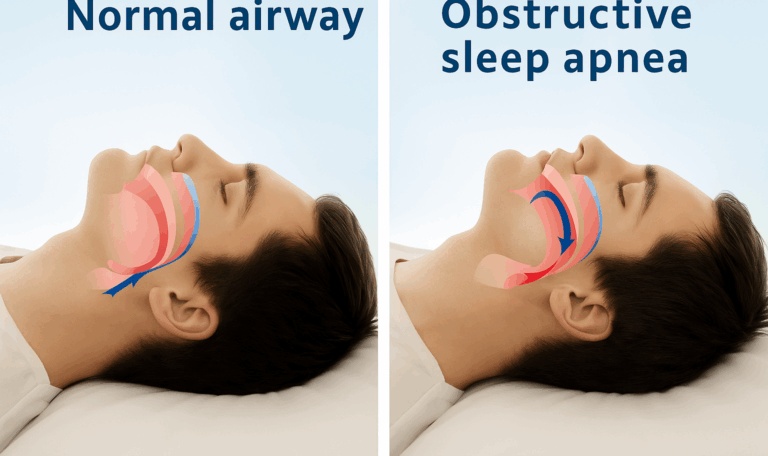
Snoring is basically the sound of tissue flapping. When you fall asleep, the muscles in your mouth and throat loosen up and your airway gets a little narrower. Air has to push through that tighter space, and soft tissue at the back of the throat (the soft palate, the uvula) vibrates as it goes. That vibration is the snore.
Plenty of everyday things make it worse: a stuffy nose, alcohol before bed, sleeping on your back, carrying extra weight around the neck, or just getting older and losing some muscle tone back there. On its own, this “simple” snoring is more of a relationship problem than a health one. It wrecks your partner’s sleep more than yours.
Where Sleep Apnea Is Different
With sleep apnea, the airway doesn’t just narrow. It actually collapses and blocks the airflow, over and over, all night long. Each pause can last several seconds, and it keeps happening until your brain notices the drop in oxygen and jolts you awake just enough to gasp and start breathing again. Then you drift back down and it repeats. People with moderate or severe apnea can go through this cycle dozens or even hundreds of times a night and never remember a second of it.
The damage is twofold: your sleep gets shredded into little pieces, and your blood oxygen keeps dipping. Left alone for years, that pattern is linked to high blood pressure, heart disease, stroke, and type 2 diabetes, on top of the daily fog, irritability, and bone-deep tiredness. The Mayo Clinic has a solid plain-English rundown if you want to go deeper on the health side.
Snoring vs Sleep Apnea: The Signs That Actually Matter
You usually can’t diagnose this by ear, but there are patterns worth paying attention to.
If your snoring is fairly steady, you wake up feeling okay, nobody’s ever caught you stop breathing, and you’re not dragging through the afternoon, it’s probably just snoring.
What tips it toward apnea is a specific rhythm: loud snoring, then a stretch of silence, then a gasp or a choke as you catch your breath. A partner is often the one who notices, because they’re lying there listening to you go quiet and then startle. Pair that with waking up unrefreshed no matter how long you slept, a dry mouth or headache in the morning, trouble concentrating, and nodding off during the day, and you’re looking at the classic apnea picture.
If any of that sounds familiar, it’s worth getting checked rather than shrugging it off.
Why You Can’t Just Go by How Loud It Is
Here’s the part people get wrong about snoring vs sleep apnea: volume doesn’t tell you much. Some of the quietest sleepers have serious apnea, and some world-class snorers have nothing wrong at all. The only way to know for sure is a sleep test that measures your breathing and oxygen levels overnight, either at a sleep lab or, for a lot of people these days, with a simpler at-home test.
So if snoring is chipping away at your sleep or your marriage, guessing isn’t a great strategy. Testing is.
What You Can Actually Do About It
The good news is that both snoring and sleep apnea respond well to treatment. Sometimes the fix is as simple as changing your sleep position, cutting back on alcohol at night, or losing a little weight. For moderate to severe apnea, a CPAP machine is still the standard.
But CPAP isn’t for everyone. Plenty of people can’t stand the mask and quietly give up on it, and that’s where a dentist comes in. A custom oral appliance is a small, retainer-like device that gently holds your lower jaw forward to keep the airway open while you sleep. No hose, no mask, no motor, and it fits in a pocket when you travel. For simple snoring and milder apnea, and especially for folks who’ve bailed on CPAP, it’s often a comfortable alternative. (The American Academy of Dental Sleep Medicine is a good outside source on how this works, and we walk through it more in our guide to custom sleep apnea devices.)
One clarification we hear a lot: a snore appliance is not the same thing as a night guard. A night guard protects your teeth from grinding. A snore appliance repositions your jaw to open your airway. Different jobs entirely.
A Few Questions We Get Often
Does snoring always mean I have sleep apnea?
No. Lots of people snore without any apnea at all. It’s the snoring plus the pauses, gasping, and daytime exhaustion that raise the flag.
Can a dentist really treat this?
For snoring and milder sleep apnea, yes. Dentists trained in dental sleep medicine make custom appliances and work alongside your physician. If apnea is on the table, treatment follows an actual medical diagnosis — we don’t skip that step.
Do I need a full sleep study just for snoring?
Not necessarily. But if there’s any hint of apnea, a test is the only way to rule it out, and it’s a small step that can protect your heart and your energy for years.
Not Sure Which One You’re Dealing With?
If snoring is wearing you (or your partner) down, don’t just live with it — find out what’s behind it. We’re happy to talk through your symptoms, help arrange testing when it makes sense, and lay out your options. Reach out to our Houston office to set up a consultation.
Dr. Friedberg & Associates
9601 Katy Freeway, Suite #360, Houston, TX 77024
Phone: (713) 464-7444
Monday – Friday: 8:00 a.m. – 5:00 p.m.
This article is for general education and isn’t a substitute for professional medical advice, diagnosis, or treatment. Obstructive sleep apnea is a medical condition diagnosed by a qualified healthcare provider.